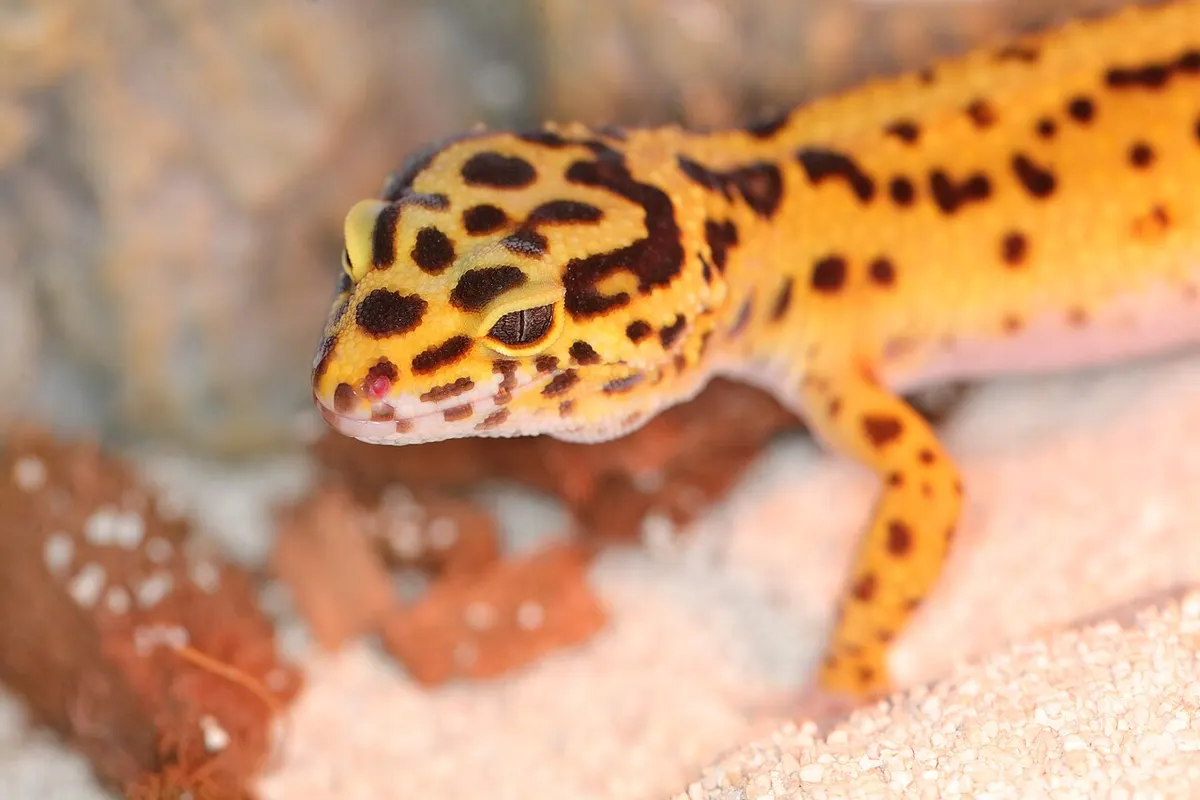
I killed my first leopard gecko’s appetite for a week by overfeeding him mealworms as a baby. He got picky, skipped meals, and I panicked and Googled everything at 1am. A proper leopard gecko feeding schedule would have saved me that week. Here’s the one I actually use now, broken down by age, with real portion sizes instead of vague “feed a few insects” advice.
Leopard geckos are insectivores their whole lives. No fruit, no veggies, no pellets that actually do anything for them. Just live feeder insects, dusted with supplements, on a schedule that changes as they grow. Get the schedule wrong and you get a gecko that’s either starving or waddling around fat with a tail like a sausage.
How often should I feed my leopard gecko
It depends entirely on age, so let’s split it three ways.
Juveniles (hatchling up to about 4 to 5 inches, roughly 0 to 5 months old) need to eat every single day. They’re building bone and muscle fast and they burn through calories doing it. Skipping days at this stage is how you end up with a stunted or weak adult.
Sub-adults (roughly 5 to 12 months old, mid-growth) can drop to every other day, or 5 to 6 feedings a week. They’re still growing but the pace has slowed down.
Adults (12 months and up, done growing) only need food 2 to 4 times a week. This is the stage most beginners get wrong. People keep feeding adults like they’re still juveniles, and six months later the gecko has a tail so fat it looks like it’s storing for a famine that isn’t coming. A slightly plump tail is normal and healthy for the species. A gecko that can barely walk because of tail size is not, and that’s worth a conversation with an exotics vet rather than just cutting food cold turkey.
What size insects can a leopard gecko eat
The rule of thumb breeders use, and it’s a good one: never feed an insect longer than the space between your gecko’s eyes. Too big and you risk impaction or a gecko that just refuses to eat it. Too small and they’re not getting enough per feeding.
For juveniles that usually means small or medium crickets, or small dubia roach nymphs. For sub-adults you move up to medium crickets or roaches. Adults can handle large crickets, adult dubia roaches, and mealworms without issue.
Leopard gecko feeding schedule by age
Here’s the full breakdown in one table. “Feeding window” is how long you leave insects in with your gecko before pulling out anything uneaten.
| Age stage | Frequency | Portion per feeding | Feeding window | Appropriate feeders |
|---|---|---|---|---|
| Juvenile (0 to 5 months) | Daily | 4 to 8 appropriately sized insects, or as many as eaten in the window | 10 to 15 minutes | Small crickets, small dubia roach nymphs |
| Sub-adult (5 to 12 months) | Every other day | 6 to 10 insects | 10 to 15 minutes | Medium crickets, medium dubia roaches, occasional mealworm |
| Adult (12+ months) | 2 to 4 times a week | 6 to 10 insects, or 4 to 6 if on the heavier side | 10 to 15 minutes | Large crickets, adult dubia roaches, mealworms, occasional waxworm or hornworm as a treat |
A couple of notes that don’t fit neatly into a table cell. Waxworms and butterworms are basically dessert. They’re high in fat and geckos will happily binge on them over healthier feeders if you let them, so keep those to an occasional treat, not a staple. Black soldier fly larvae (sometimes sold as Phoenix worms or Repashy grubs) have a naturally better calcium to phosphorus ratio than crickets or mealworms, which makes them a solid staple option if your gecko takes to them.
Do leopard geckos need calcium powder every feeding
Yes, and this is the part people skip once they get comfortable. Dust feeder insects with a plain calcium powder at every feeding for juveniles and sub-adults. For adults, calcium at every feeding is still fine, but at minimum hit 2 to 3 feedings a week.
Calcium with vitamin D3 added should be used more sparingly, usually once or twice a week, unless your gecko has zero UVB exposure, in which case you lean on D3 more. Too much D3 dusting can cause its own problems, so don’t just dust every insect with the D3 version by default. Check the label and rotate between plain calcium and calcium with D3.
What is gut loading and do I really need to do it
Gut loading just means feeding your feeder insects nutritious food for a day or two before they become your gecko’s dinner. A cricket that’s been eating cardboard and old carrot scraps passes almost nothing useful along. A cricket that’s been eating a proper gut load full of grains, greens, and calcium passes that nutrition straight to your gecko.
You don’t need anything fancy. A commercial gut load powder mixed into water or fresh veggies works fine. Do it consistently and skip the powder dusting on lazy weeks, and your gecko will still come out ahead of one fed unloaded insects.
Why is my leopard gecko not eating
Before you panic, check three things. First, temperature. Geckos are ectotherms and if the warm side of the tank isn’t in the mid 80s Fahrenheit, digestion slows down and appetite drops with it. Second, shedding. A gecko about to shed often goes off food for a day or two, totally normal. Third, overfeeding fatty treats like waxworms, which can make a gecko turn its nose up at healthier staple insects for a while.
If a gecko goes more than a week or two without eating and none of those explain it, that’s a vet visit, not a forum post. Sudden or prolonged appetite loss can be a sign of illness and this article isn’t a substitute for an actual exam from a reptile vet.
The short version
- Juveniles (0 to 5 months) eat daily, roughly 4 to 8 small insects per feeding.
- Sub-adults (5 to 12 months) eat every other day, roughly 6 to 10 medium insects per feeding.
- Adults (12+ months) eat 2 to 4 times a week, roughly 6 to 10 insects per feeding.
- Never feed an insect bigger than the space between your gecko’s eyes.
- Dust with plain calcium at every feeding for juveniles and sub-adults, and at least 2 to 3 times a week for adults.
- Use calcium with D3 only once or twice a week unless your gecko has no UVB source.
- Waxworms, butterworms, and hornworms are treats, not staple food, because of their high fat content.
- A gecko that skips food for more than a week or two with no obvious cause needs a vet, not a wait-and-see approach.
Getting the leopard gecko feeding schedule right is honestly the easiest part of keeping one once you’ve done it a couple weeks in a row. The harder part for most beginners is everything around it, the enclosure setup, the temperature gradient, the supplement rotation. If you’re still working through the basics, our full guide to leopard gecko care for beginners covers the whole picture, and if you haven’t bought your setup yet, the leopard gecko starter kit checklist will save you from buying the wrong tank size twice like I did. Deciding between species in the first place? Our bearded dragon vs leopard gecko comparison breaks down the real differences in care level and cost.
For more on the medical side of feeding, including impaction and metabolic bone disease, VCA Animal Hospitals has a solid overview in their leopard gecko care and feeding guide, and LafeberVet’s basic information sheet on leopard geckos is written for veterinary staff but is genuinely useful for owners too.