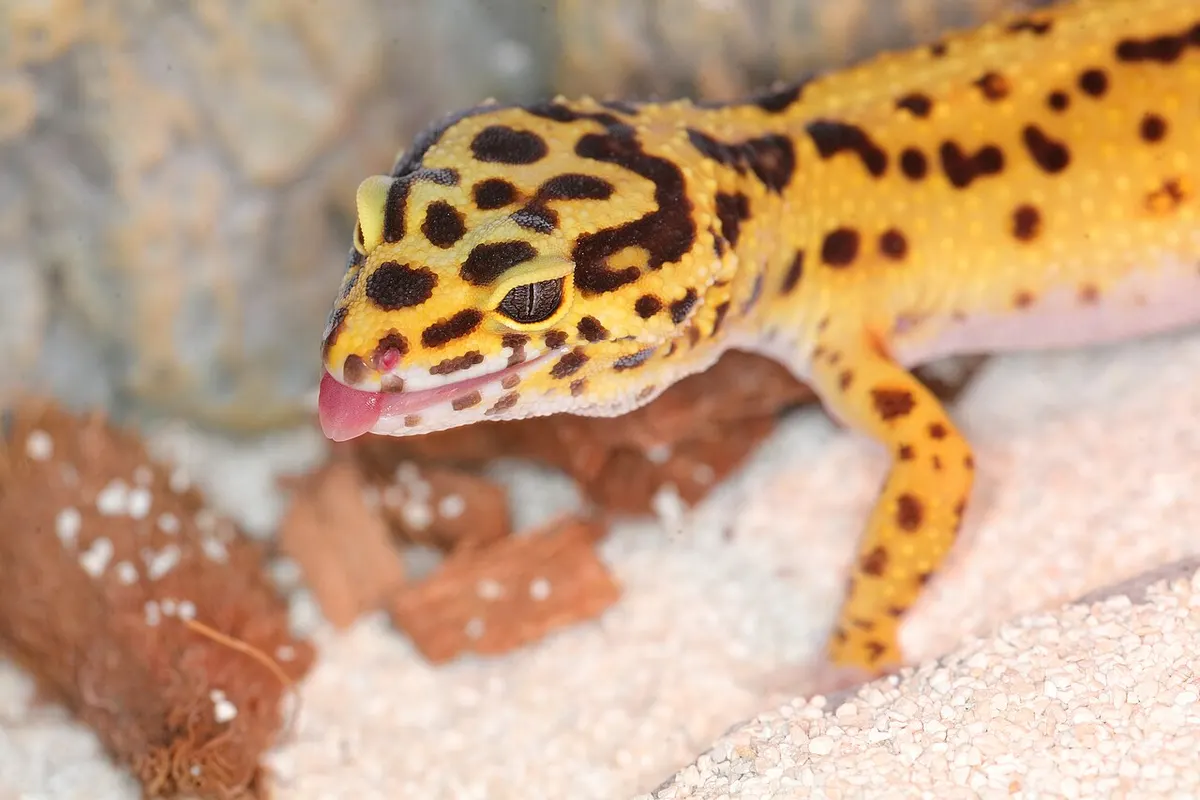
I’ve kept leopard geckos for years, and this is the leopard gecko care guide for beginners I wish someone had handed me before my first one showed up in a deli cup with holes punched in the lid. Leopard geckos are genuinely one of the easiest reptiles to start with. They’re small, calm, don’t need a blazing sunlamp running all day, and they’ll happily eat the same handful of foods for a decade. But easy doesn’t mean no setup. Get the enclosure, heat, or substrate wrong in month one and you’ll spend the next year fixing problems instead of enjoying the animal. Here’s everything to sort out before day one.
What size enclosure does a leopard gecko need?
A single adult needs at least a 20 gallon long tank, the 30 by 12 by 12 inch size, not the taller 20 gallon “high” that pet stores love to sell. Floor space is what matters here, not height. Leopard geckos are ground dwelling and barely climb, so a tall narrow tank wastes space they’ll never use while shortchanging the space they actually need.
If you can swing it, start bigger. A 36 by 18 inch enclosure, roughly 40 gallons of floor space, gives you room for a real thermal gradient, and that gradient is the single biggest thing separating an easy setup from a stressful one. You want a warm end, a cool end, and enough distance between them that your gecko can actually pick a temperature instead of baking or freezing no matter where it sits.
Heat mat or heat lamp: which one does a leopard gecko need?
Leopard geckos are ground foragers, active around dawn and dusk, and they warm up through their belly rather than by basking under a bulb the way a bearded dragon does. That’s why the standard setup is an adhesive heat mat stuck to the outside of the tank, under one end only, wired through a thermostat.
The thermostat is not optional. A heat mat plugged straight into a wall outlet has no way to shut itself off, and mats have cooked geckos to death inside a single hot weekend. Size the mat to cover no more than a third to a half of the floor, so the rest of the tank stays a genuine cool zone.
A low wattage heat lamp or ceramic heat emitter can work as a supplement if your room runs cold overnight, but for most beginners a thermostat controlled heat mat is the simpler, cheaper, and safer starting point.

Keeper's pick: BN-LINK 6x8 Reptile Heating Pad with Digital Thermostat
A good one to recommend to first time keepers because the mat and thermostat come as a matched pair, so there's no guessing whether your controller can actually handle the wattage. The digital thermostat makes it easy to dial in a warm side target instead of eyeballing a dial, and the probe lets you place the sensor exactly where your gecko sits, not just wherever the mat happens to be.
Do leopard geckos need UVB light?
For a long time the hobby answer was a flat no, since leopard geckos are crepuscular and hide from direct sun. That’s not wrong, but it’s not the whole picture either. Leopard geckos in the wild still get incidental UV exposure at dawn and dusk, and current husbandry guidance leans toward offering a low level UVB source, something in the 2 to 6 percent range, as good practice rather than a strict requirement.
So the honest nuance is this: your gecko will survive without UVB if you dust feeder insects with calcium on a consistent schedule. It may do better with a low output UVB tube positioned over part of the enclosure, since UVB helps the body synthesize vitamin D3 on its own instead of relying entirely on supplements. If your budget allows one more piece of gear, a low UVB bulb is a reasonable upgrade, not a mandatory one. For a deeper look at the research behind this, LafeberVet’s UVB lighting for reptiles guide is written by veterinarians and is worth a read before you decide.
What substrate is safe for a leopard gecko tank?
For a beginner setup, keep it simple: paper towels, plain unprinted newspaper, reptile carpet, or textured slate and tile tiles cut to fit the tank floor. All of these are cheap, easy to clean, and carry zero impaction risk.
Loose substrates, fine sand, coconut fiber blends, or bioactive soil mixes, can look nicer and some experienced keepers run them successfully. But they come with real risk for young or clumsy geckos that ingest substrate while hunting, and “calcium sand” marketed as digestible is not something I’d trust with a new gecko. Save loose substrate experiments for after you’ve got a season of confident handling under your belt. Full husbandry background, including substrate and enclosure notes, is covered in the Merck Veterinary Manual’s management and husbandry of reptiles reference.
Leopard gecko temperature and humidity targets
| Zone | Target |
|---|---|
| Warm side floor temp | 88 to 92°F |
| Cool side floor temp | 72 to 75°F |
| Ambient room temp (night) | Not below 65°F |
| Basking air temp above mat | Up to 95°F briefly is fine |
| Humidity, general | 30 to 40% |
| Humidity, inside humid hide | 70 to 80% |
Use a digital probe thermometer on both the warm and cool floor, not a stick on dial gauge. Dial gauges are frequently off by 5 to 10 degrees, and that’s a big enough margin to either underheat digestion or risk a burn.
What do leopard geckos eat and how often?
Leopard geckos are insectivores. Staple feeders are crickets and dubia roaches, sized no larger than the space between the gecko’s eyes. Mealworms work as an occasional addition. Waxworms and superworms are treat only, they’re fatty and geckos will happily overeat them if you let them.
Every feeder insect should be gut loaded (fed nutritious food itself for 24 hours before serving) and dusted with a calcium powder. Most keepers dust with plain calcium (no D3) most feedings, and a calcium with D3 or a multivitamin powder once or twice a month, adjusted depending on whether you’re running UVB.
| Age | Feeding frequency | Typical feeder size |
|---|---|---|
| Hatchling (0 to 3 months) | Daily | Small crickets or 1/4 inch dubia |
| Juvenile (3 to 12 months) | Every 1 to 2 days | Medium crickets or 1/2 inch dubia |
| Adult (12+ months) | Every 2 to 3 days | Adult crickets or full size dubia |
Always offer food in a shallow dish rather than scattering loose insects across loose substrate, and remove uneaten feeders after 15 to 20 minutes so they’re not stressing your gecko overnight.
How do you handle a leopard gecko without stressing it out?
Give a new gecko 1 to 2 weeks to settle in before any handling beyond feeding and spot cleaning. When you do start, let it walk onto your open hand rather than grabbing from above, which reads as predator behavior to a small ground dwelling lizard.
Never grab or pinch the tail. Leopard geckos can drop their tails when they feel threatened, a defense called autotomy, and while the tail regrows, it never looks quite the same and the process is stressful for the animal. Keep early sessions to 5 or 10 minutes, and read body language: a raised tail, dark coloring, or barking sounds mean put it back and try again tomorrow.
What mistakes do beginners make with leopard gecko care?
- Skipping the thermostat and running a heat mat directly off the wall outlet.
- Buying a tall “20 gallon high” tank instead of the long, low floor space version.
- Using loose sand or calcium sand for a young or newly acquired gecko.
- Handling constantly in the first week instead of letting the gecko settle first.
- Dusting every single feeding with calcium plus D3, which can lead to oversupplementation over months.
- Forgetting a humid hide, which makes shedding difficult and can leave retained skin on toes.
- Trusting a stick on dial thermometer instead of checking actual floor temperature with a probe.
The short version
- Adult leopard geckos need a minimum 20 gallon long tank (30 by 12 by 12 inches), not a taller 20 gallon high tank.
- Warm side floor temperature should read 88 to 92°F, cool side 72 to 75°F, checked with a digital probe thermometer.
- A heat mat must run through a thermostat. Without one, mats have overheated and killed geckos.
- Leopard geckos do not strictly require UVB, but low level UVB in the 2 to 6 percent range is considered beneficial best practice.
- Safe beginner substrates are paper towel, reptile carpet, or tile. Loose sand carries impaction risk for young geckos.
- Hatchlings eat daily, juveniles every 1 to 2 days, adults every 2 to 3 days, with feeders dusted in calcium.
- Leopard geckos can drop their tails under stress (autotomy). Never grab or squeeze the tail.
- Humidity should stay around 30 to 40% overall, with a humid hide at 70 to 80% to support clean shedding.
That covers the core of this leopard gecko care guide for beginners: enclosure size, heat and thermostat safety, the UVB nuance, substrate choice, feeding, and handling. Get those fundamentals right in the first month and most of the common leopard gecko problems simply never come up.
If you’re still deciding whether a leopard gecko or a bearded dragon fits your setup better, our bearded dragon vs. leopard gecko comparison breaks down the differences beginners actually care about. Once you’ve got a gecko coming home, our complete starter checklist lists exactly what to buy before it arrives, and our leopard gecko diet guide goes deeper into feeder rotation and supplementation schedules than we could cover here.