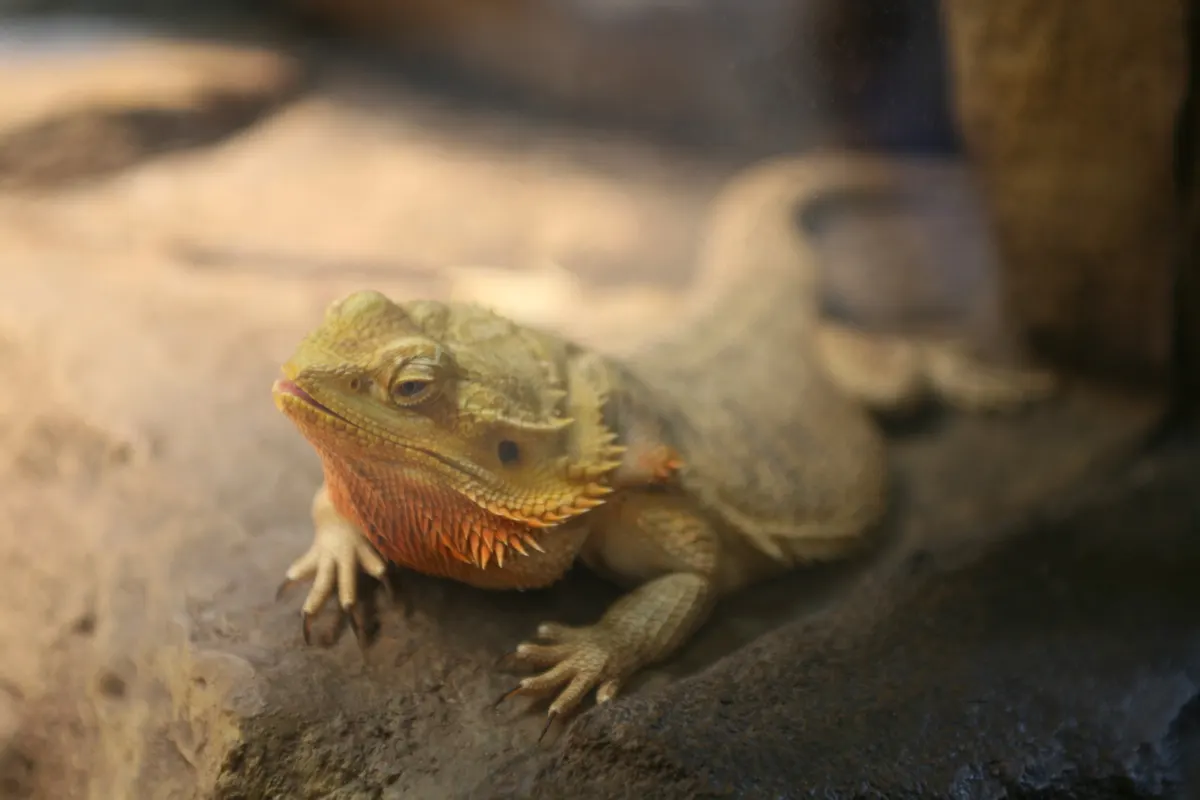
I keep bearded dragons, and every one I’ve owned has taught me something I wish I’d known on day one. This is the bearded dragon care guide for beginners I wish someone had handed me before my first dragon came home in a shoebox with holes punched in the lid. It covers the enclosure, the lighting, the temperatures, the food, and the handling, in that order, because that’s the order that actually keeps a dragon alive.
Bearded dragons are one of the most forgiving lizards you can start with. They’re not fragile, they’re not fussy about being touched, and they tolerate a beginner’s early mistakes better than most reptiles. But “forgiving” isn’t the same as “no effort.” Here’s what the setup actually needs.
What size enclosure does a bearded dragon need?
A baby dragon can start in a 20 gallon long tank, but it grows out of that fast. By the time your dragon hits adult size, around 16 to 24 inches nose to tail, it needs a minimum 40 gallon breeder tank (36 x 18 x 18 inches). I’d go bigger if your budget allows it. In my own setup I run 4x2x2 foot enclosures for adults, and the dragons use every inch of that floor space.
Skip the tall, narrow “20 gallon high” tanks marketed for beginners. Bearded dragons are ground dwellers. They want floor space and basking length, not vertical climbing room. A wide, low enclosure beats a tall one every time.
What lighting and UVB setup does a bearded dragon need?
This is the part people get wrong most often, and it’s the part that matters most for long term health. A bearded dragon needs two separate lights: a basking bulb for heat, and a UVB tube for calcium metabolism.
For UVB, use a linear T5 HO 10.0 bulb that runs at least half the length of the tank, mounted inside the enclosure with no glass or mesh screen blocking more than a fraction of the output. Compact coil UVB bulbs are cheaper but produce weaker, less even UVB, and I don’t recommend them for a beginner’s only light source.
UVB output drops well before the bulb stops producing visible light, so replace the tube on a schedule, not when it looks dim. Most linear T5 HO bulbs are rated for about 12 months of effective UVB output; compact and coil bulbs closer to 6 months. Write the install date on the bulb with a marker so you’re not guessing later.

Keeper's pick: MCLANZOO UVA UVB 10.0 26W Reptile Bulb
This is the style of bulb I point beginners toward when they're not ready to commit to a full T5 HO fixture yet. It's a straightforward screw-in UVB bulb that fits a standard dome fixture, and it comes with a UV test card so you can actually check output instead of guessing. It's not a substitute for a proper linear T5 HO setup long term, but it's a solid, affordable way to get real UVB into a first enclosure.
What temperature and humidity does a bearded dragon need?
Bearded dragons are desert animals. They need a hot basking spot on one side of the tank and a cooler retreat on the other, so the dragon can move back and forth to regulate its own body temperature. This gradient is the single most important thing to get right, more important than the exact brand of tank or the color of your substrate.
| Life stage | Basking spot | Cool side | Nighttime low | Humidity |
|---|---|---|---|---|
| Baby (0 to 4 months) | 100 to 110°F | 80 to 85°F | 70 to 75°F | 30 to 40% |
| Juvenile (4 to 12 months) | 95 to 105°F | 80 to 85°F | 65 to 75°F | 30 to 40% |
| Adult (12+ months) | 95 to 100°F | 75 to 85°F | 65 to 75°F | 30 to 40% |
Use a digital probe thermometer with the probe sitting right at basking spot level, not a stick-on strip on the glass. Stick-on strips read the glass temperature, not the air or surface temperature your dragon is actually sitting in, and they’re consistently off by enough to matter.
What do bearded dragons eat by age?
Feeding ratios flip as a dragon grows. Babies need lots of protein to fuel rapid growth. Adults need mostly plant matter, and too many fatty feeder insects as an adult is a fast track to a fat, unhealthy dragon.
| Age | Feeder insects | Greens and veggies | Frequency |
|---|---|---|---|
| Baby (0 to 3 months) | About 80% of diet | About 20% of diet | 2 to 3 feedings a day |
| Juvenile (3 to 12 months) | About 50% of diet | About 50% of diet | 1 to 2 feedings a day |
| Adult (12+ months) | About 20% of diet | About 80% of diet | Insects every other day, greens daily |
Stick to appropriately sized feeders, roughly no wider than the space between your dragon’s eyes, since oversized feeders are a real cause of impaction and paralysis in young dragons. Dust feeders with calcium powder at most feedings, and use a calcium with D3 if your UVB setup or sun exposure is limited.
How do you handle a bearded dragon?
Give a new dragon at least a week to settle into its enclosure before you start handling it regularly. Let it eat, bask, and explore on its own schedule first.
When you do pick one up, scoop from underneath with an open hand rather than grabbing from above, and support the body and tail rather than letting them dangle. Keep early sessions short, five to ten minutes, and read the dragon’s body language. A black beard, puffed-up posture, hissing, or repeated glass surfing all mean stop and try again later, not push through it.
What are the most common bearded dragon care mistakes beginners make?
I’ve made most of these myself, and I see new keepers repeat them constantly:
- Buying a 20 gallon tank and never upgrading as the dragon grows into an animal that needs four times that floor space.
- Using loose sand or calcium sand substrate for a baby dragon, which raises impaction risk during the stage when dragons are clumsiest with their tongues.
- Skipping UVB replacement because the bulb still lights up, even though the actual UVB output has already dropped off.
- Trusting a stick-on thermometer strip instead of a real probe thermometer at basking height.
- Feeding an adult dragon like a baby, with too many fatty feeder insects and not enough greens, leading to obesity and liver problems.
- Housing two bearded dragons together. They’re territorial, not social, and cohabitation reliably ends in stress, injury, or a dragon that stops eating.
The short version
- Adult bearded dragons need a minimum 40 gallon breeder tank, ideally larger, since they’re ground dwelling lizards that use floor space.
- A basking spot of 95 to 110°F is standard depending on age, with a cooler side of 75 to 85°F for thermoregulation.
- Bearded dragons need a UVB bulb, ideally a linear T5 HO 10.0, replaced roughly every 6 to 12 months regardless of whether it still produces visible light.
- Ideal humidity for a bearded dragon enclosure is 30 to 40%, well below what’s needed for tropical reptile species.
- Baby bearded dragons eat a diet that’s roughly 80% feeder insects, while adults flip to roughly 80% greens and vegetables.
- Feeder insects should be no wider than the space between a dragon’s eyes to reduce impaction risk.
- New bearded dragons should be given about a week to settle in before regular handling begins.
- This bearded dragon care guide for beginners covers the core setup; tank size and feeding schedules have their own dedicated breakdowns linked below.
For deeper detail on housing and diagnosing symptoms, Washington State University’s Veterinary Teaching Hospital has a solid bearded dragon husbandry overview, and UC Davis’s School of Veterinary Medicine publishes a similarly useful bearded dragon care reference.
If you’re still deciding whether a bearded dragon is the right first reptile, read Bearded Dragon vs. Leopard Gecko: Which Is Easier for Beginners? before you buy anything. If you’ve already decided, our tank size breakdown goes deeper on exact dimensions for each life stage, and our first year cost of ownership guide will save you from underbudgeting the setup.