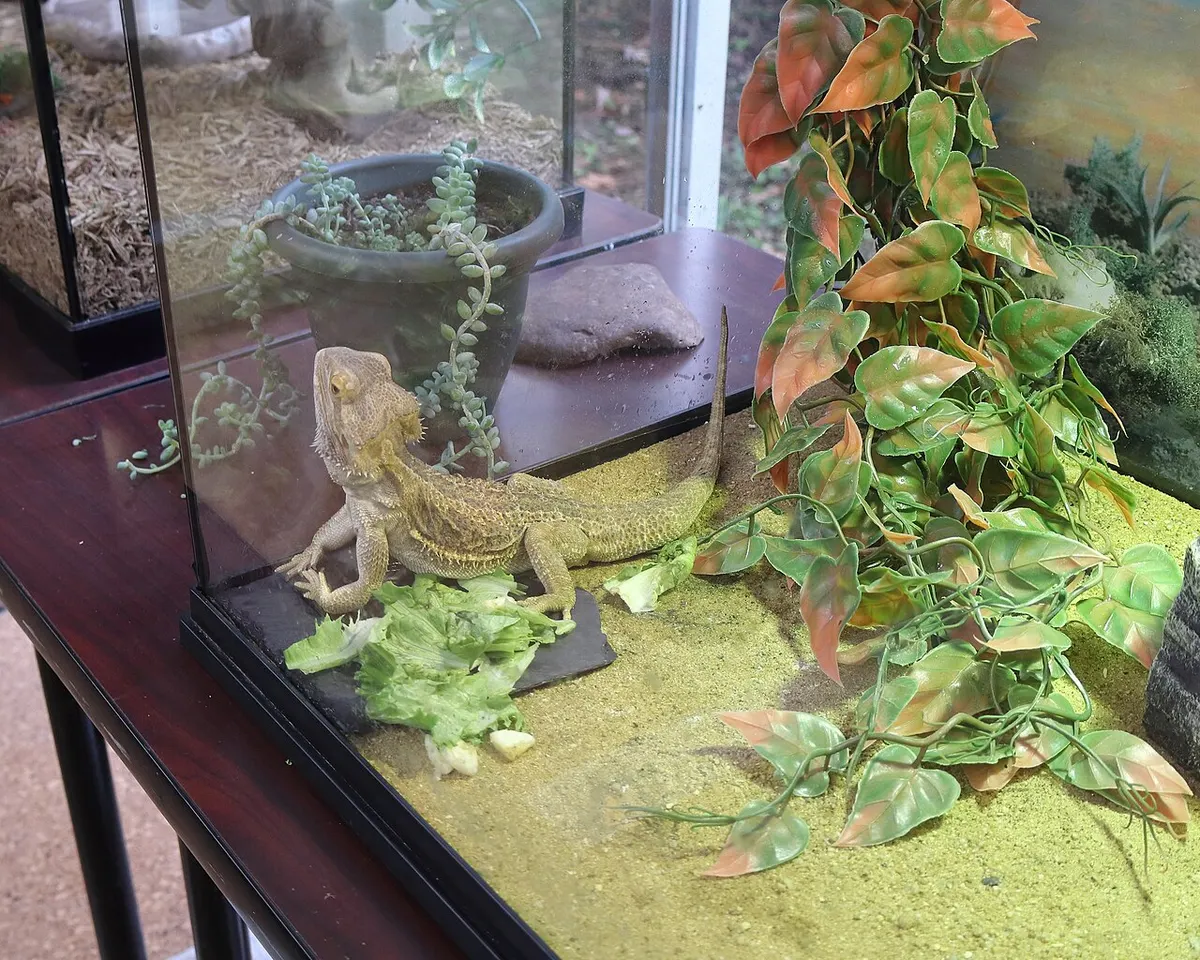
Bearded dragon tank size is the first thing new keepers get wrong, and it’s usually not their fault. Pet store starter kits are built around a 20 gallon tank because that’s a size stores can stock cheaply, not because it’s what a dragon needs long term. Here’s the honest answer, broken down by age, with the actual dimensions you should be shopping for.
Short version up front: a hatchling can start in a 20 to 40 gallon tank, but by the time your dragon is a year old you’re looking at 75 to 120 gallons, or the equivalent footprint in a PVC or wood enclosure. If you buy once, buy for adult size.
What size tank does a baby bearded dragon need?
A hatchling, roughly 3 to 4 inches long and under 3 months old, does fine in a 20 gallon tank (about 36 by 18 by 18 inches). Some keepers go straight to a 40 gallon breeder tank (48 by 18 by 18 inches) because it means one less upgrade later, and that’s a reasonable call if your budget allows it.
What you don’t want is a tank that’s too big for a hatchling to navigate. A baby dragon in a cavernous enclosure can struggle to find food and basking spots, and it makes temperature gradients harder to manage. Twenty to 40 gallons is the sweet spot for the first few months.
What size tank does a juvenile bearded dragon need?
Somewhere between 3 and 12 months, your dragon is growing fast, sometimes an inch every couple weeks. This is where the 20 gallon starter tank stops being enough. Most care guides put the juvenile minimum at 40 gallons, with 75 gallons (48 by 24 by 24 inches) as the better target once your dragon passes about 10 inches.
I’ve watched people try to stretch a 20 gallon tank through this whole stage to save money. It doesn’t save money. You just buy the 40 gallon tank a few months later anyway, and now you’ve paid for two tanks instead of one.
What size tank does an adult bearded dragon need?
A full grown bearded dragon, typically 16 to 24 inches long by 12 to 18 months old, needs a minimum of 75 gallons, with 120 gallons (72 by 24 by 24 inches) recommended by most major care sources for long term comfort.
Here’s where it gets a little more complicated. The old standard for years was that 40 to 75 gallons was fine for an adult. That guidance has shifted. ReptiFiles, one of the most cited reptile husbandry sources online, now recommends a 6 foot by 2 foot by 2 foot enclosure as the standard for adult bearded dragons, which works out to roughly the volume of a 120 gallon tank, with a 4x2x2 footprint (about 120 gallons equivalent) as the bare minimum for a smaller adult. Zen Habitats, which builds PVC enclosures specifically for bearded dragons, states the same 4x2x2 minimum and points out that a dragon started in a smaller tank usually needs the adult-sized enclosure within 6 to 8 months anyway.
So the honest range you’ll see across sources is 75 to 120+ gallons for an adult, with the more current recommendation trending toward the larger end. If you’re buying once, aim for the 120 gallon equivalent footprint.
Bearded dragon tank size by age (table)
These numbers reflect the consensus range across major care sources. Treat them as a range, not a single fixed number, since exact figures vary slightly by source.
| Life stage | Approx. age | Approx. length | Minimum tank size | Minimum footprint |
|---|---|---|---|---|
| Hatchling | 0 to 3 months | 3 to 9 inches | 20 gallon | 36 x 18 x 18 in |
| Juvenile | 3 to 12 months | 9 to 16 inches | 40 gallon | 48 x 18 x 18 in |
| Sub-adult | 8 to 12 months | 13 to 20 inches | 75 gallon | 48 x 24 x 24 in |
| Adult | 12+ months | 16 to 24 inches | 75 to 120 gallon (current best practice trends toward the 120 gallon / 4x2x2 ft end) | 48 x 24 x 24 in to 72 x 24 x 24 in |
Sources for these ranges include Chewy’s bearded dragon tank size guide, ReptiFiles’ terrarium size breakdown, and Zen Habitats’ enclosure size guide. For a veterinary perspective on housing basics, VCA Animal Hospitals’ bearded dragon housing page is a solid, non-commercial reference.
Can I skip straight to an adult size tank?
Yes, and a lot of experienced keepers recommend exactly that. Starting a hatchling in an adult-sized enclosure isn’t harmful as long as you section off part of the space temporarily, using cardboard, foam board, or a divider, so the baby doesn’t have to search a huge open floor for food and heat. Once it grows into the space over the next several months, you remove the divider.
This approach costs more upfront but less overall, since you’re not buying a 20 gallon, then a 40 gallon, then a 75 or 120 gallon enclosure in sequence. If you know you’re keeping this dragon for its full lifespan, which can run 8 to 12 years, buying the adult enclosure first is usually the cheaper path.
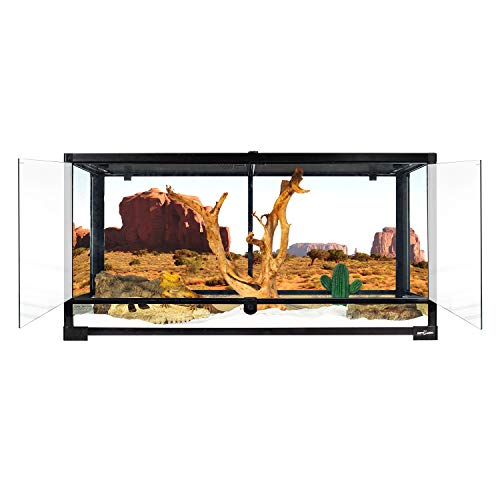
Keeper's pick: REPTI ZOO 50 Gallon Glass Terrarium
A solid step-up tank for the juvenile stage: 36 by 18 by 18 inches of glass with double hinged front doors, so you're not reaching over a basking lamp every time you feed, and a screen top for ventilation. It's not going to be your forever enclosure once your dragon hits full adult size, but it's a legitimate middle step between a hatchling tub and a 120 gallon setup, and the front doors make daily handling noticeably easier than a top-opening tank.
How do I know if my bearded dragon’s tank is too small?
A few signs point to an undersized enclosure. Glass surfing, where your dragon repeatedly scratches at the corners or walls, is a common one. So is a dragon that can’t get more than a couple feet from the basking spot to the cool side, which makes proper thermoregulation impossible. If your dragon looks cramped when stretched out, or if you can’t fit a full temperature gradient (a hot basking end and a cooler end with at least a 20 degree difference) inside the footprint, the tank is too small for that life stage.
Undersizing isn’t just a comfort issue either. Cramped enclosures make it harder to hit the temperature and UVB gradients a dragon needs to digest food and metabolize calcium correctly, which ties directly into metabolic bone disease risk down the line.
The short version
- Hatchlings (0 to 3 months, 3 to 9 inches) do fine in a 20 to 40 gallon tank.
- Juveniles (3 to 12 months, 9 to 16 inches) need a minimum of 40 gallons, with 75 gallons recommended once they pass about 10 inches.
- Adult bearded dragons (12+ months, 16 to 24 inches) need a minimum of 75 gallons, with 120 gallons or a 4x2x2 to 6x2x2 foot PVC or wood enclosure now recommended by sources like ReptiFiles and Zen Habitats.
- A 120 gallon tank measures roughly 48 by 24 by 24 inches to 72 by 24 by 24 inches, depending on the exact model.
- Bearded dragons typically reach full adult size between 12 and 18 months old.
- Buying an adult-sized enclosure upfront, with a temporary divider for a hatchling, usually costs less overall than upgrading tank size three times.
- An undersized tank makes it harder to maintain the temperature gradient a dragon needs to digest food properly.
- Bearded dragon tank size recommendations have trended larger over the past decade, so older care sheets often understate what’s now considered adequate.
If you’re still deciding between species before you commit to a tank at all, our bearded dragon versus leopard gecko comparison walks through the space, temperament, and cost differences. Once you’ve got the enclosure question narrowed down, our full beginner’s guide to bearded dragon care covers lighting, temperature, and feeding on top of housing. And if you want the full picture of what this hobby costs before you buy anything, check our bearded dragon cost of ownership breakdown.