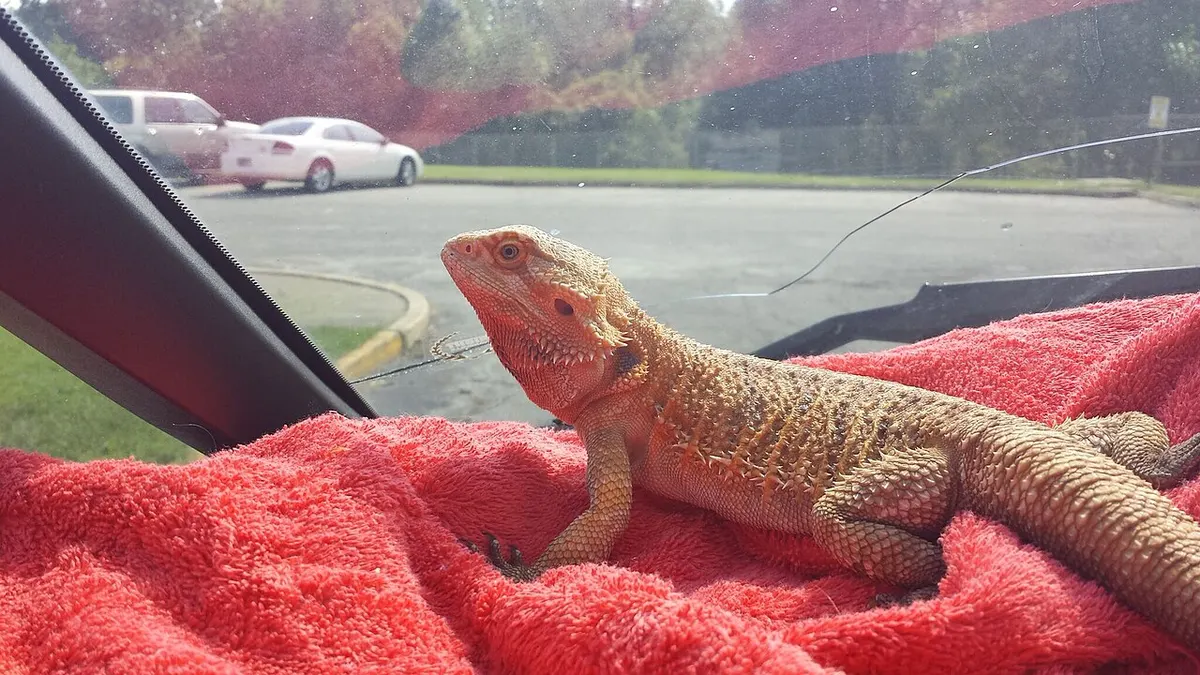
The best UVB bulb for a bearded dragon is a linear T5 HO tube, either a 10 to 12% desert strength or a 14% for tall enclosures, sized to about half the length of the tank and mounted 8 to 18 inches above the basking spot depending on strength and whether there’s mesh in the way. That’s the whole answer. The rest of this article is the details that keep you from getting it subtly wrong.
And people do get it wrong. My first dragon’s tank came with a little screw-in coil UVB bulb, because that’s what the box kit included and I didn’t know any better. It looked bright. It was doing almost nothing at the distance it was mounted. Bulbs are the one piece of bearded dragon gear where “it lights up” tells you nothing about whether it works.
Why does a bearded dragon need a UVB bulb at all?
Bearded dragons make vitamin D3 in their skin when it’s hit by UVB light, and they need that D3 to absorb calcium from their food. No UVB means poor calcium absorption, and over months that leads to metabolic bone disease: soft jaws, bowed legs, tremors. Calcium powder with D3 helps, but it’s a backup, not a replacement for proper lighting.
Wild bearded dragons live in open Australian scrub and desert, and lighting specialists classify them as Ferguson Zone 3, the group of reptiles that bask in full sun. Reptile lighting guidance puts their peak basking UV index somewhere in the 2.9 to 7.4 range, with ReptiFiles’ bearded dragon lighting guide targeting a UVI of about 4.0 to 4.5 at the basking spot and a gradient down to zero in the shade. A weak bulb can’t hit that number at any sane distance. That’s the problem with most coil bulbs and older T8 tubes.
T5 HO vs. T8 vs. coil vs. mercury vapor: which UVB type is best?
| Bulb type | Typical UVB reach | Replace every | Best for | Verdict |
|---|---|---|---|---|
| T5 HO linear (10 to 14%) | Strong to about 12 to 18 inches | 12 months | Almost every bearded dragon setup | Best choice |
| T8 linear (10.0) | Weak past about 8 to 12 inches | 6 months | Short tanks, tight budgets | Works if mounted close, outdated |
| Compact or coil | Narrow hotspot, weak spread | About 6 months | Not recommended for dragons | Skip it |
| Mercury vapor (self-ballasted) | Strong, also produces heat | About 12 months | Very tall or walk-in enclosures | Advanced keepers only |
T5 HO (high output) tubes are thinner than T8s but push far more UVB, and they spread it across a wide strip of the tank instead of a single spot. That wide, even spread is what lets a dragon soak up UVB while basking and retreat to low UV at the cool end. This is the type nearly every current care source recommends, and it’s what I’d buy.
T8 tubes were the standard 15 years ago. They still work if they’re mounted close to the dragon, but they lose strength fast and need replacing about twice as often, so the savings disappear by year two.
Coil and compact UVB bulbs concentrate output into a small zone and fall off quickly with distance. Several care sources specifically warn against them for bearded dragons. If your kit came with one, treat it as a placeholder until a T5 arrives.
Mercury vapor bulbs put out UVB, visible light, and heat in one bulb. They’re useful in very tall enclosures, but they need a ceramic socket, can’t go on a dimmer or thermostat, and make it harder to tune heat and UVB separately. I wouldn’t hand one to a beginner.
Should you get a 10%, 12%, or 14% UVB bulb?
The percentage is roughly how much of the bulb’s output is UVB, and higher means you can mount it farther away and still hit the target UV index. It’s not “more is better.” It’s “match strength to distance.”
- 10% (Zoo Med ReptiSun 10.0 T5 HO): suits standard 18 to 24 inch tall enclosures where the basking spot sits fairly close to the top.
- 12% (Arcadia Desert 12%): the most commonly recommended strength for a typical 4 x 2 x 2 foot setup, with a bit more working distance than a 10%.
- 14% (Arcadia Dragon 14%): made for tall enclosures where the bulb ends up 15 inches or more above the dragon.
Whichever you buy, the goal is the same: about 4.0 to 4.5 UVI at the basking platform and close to zero in the far cool corner.
What wattage and length UVB bulb do you need?
With T5 HO tubes, wattage follows length, so pick length first. The usual rule from husbandry sources is a tube about half to two-thirds the length of the enclosure, mounted on the same side as the heat lamp so the dragon gets heat and UVB in the same spot.
| Enclosure length | T5 HO tube length | Approx. wattage |
|---|---|---|
| 3 feet (36 inches) | 22 inches | 24 W |
| 4 feet (48 inches) | 22 inches | 24 W |
| 4 feet, tall or extra bright | 34 inches | 39 W |
| 6 feet (72 inches) | 34 inches | 39 W |
If you’re not sure how big the tank itself should be, our bearded dragon tank size guide walks through sizing from baby to adult.
How far should a UVB bulb be from a bearded dragon?
This is where most setups quietly fail. A great bulb at the wrong height is a mediocre bulb. Rough starting distances, measured from the bulb down to the top of the basking platform:
| Bulb | Over mesh | No mesh (inside enclosure) |
|---|---|---|
| ReptiSun 10.0 T5 HO | About 8 to 10 inches | About 10 to 12 inches |
| Arcadia Desert 12% | About 11 inches | About 16 to 17 inches |
| Arcadia Dragon 14% | About 11 to 12 inches | About 17 to 18 inches |
The mesh numbers are lower because a typical screen lid blocks roughly a third of the UVB passing through it, and fine mesh blocks more. A reflector behind the tube pushes more output downward, which is why most good T5 fixtures include one.
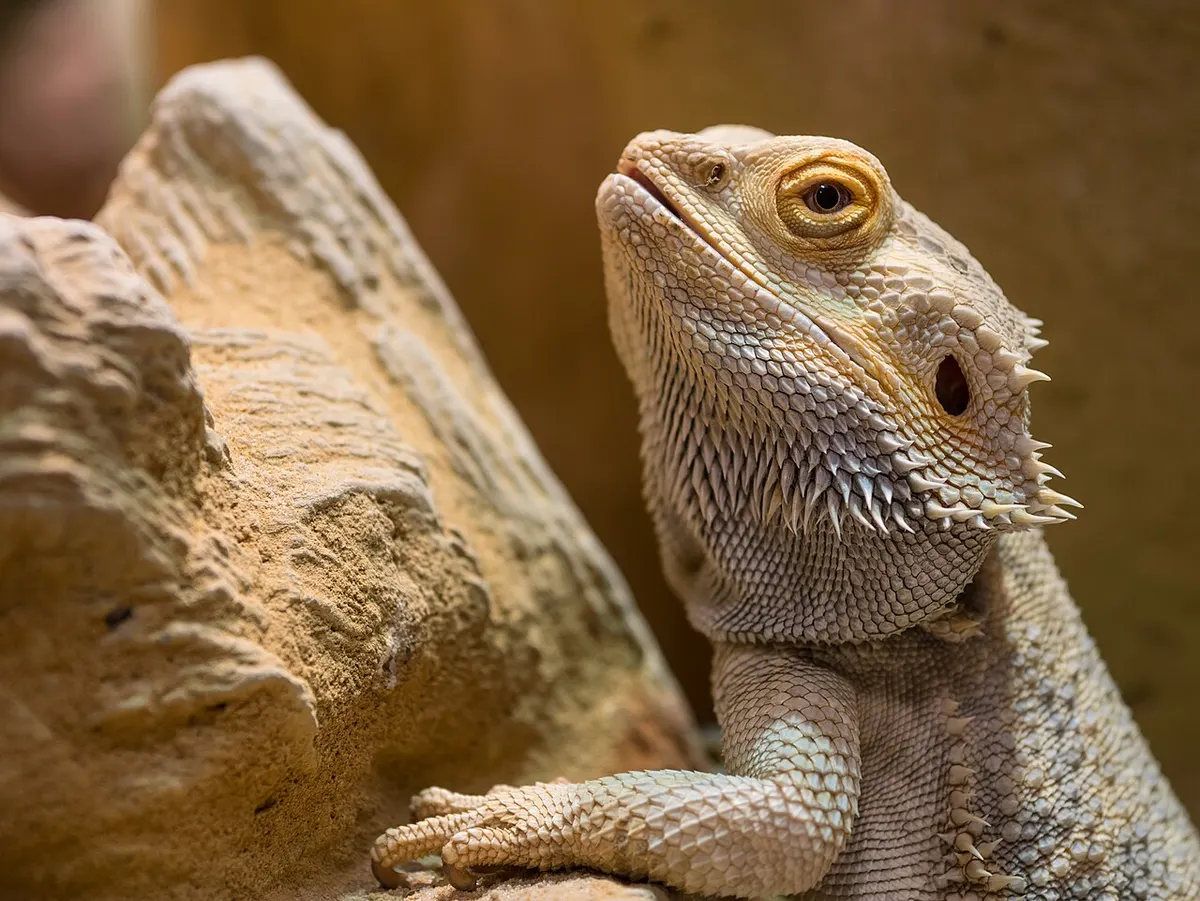
Photo: Basotxerri, CC BY-SA 4.0, via Wikimedia Commons
These distances are starting points, not guarantees. Fixtures, reflectors, and mesh vary. The only way to know what your dragon is actually getting is a UV index meter at the basking spot. If that’s not in the budget yet, stick to the manufacturer’s distance chart for your exact bulb and don’t improvise.
The best UVB bulbs for bearded dragons right now
These picks are based on published output specs, what established husbandry sources recommend, and verified owner reviews, plus price-to-value for a beginner setup.
Keeper's pick: MIXJOY T5 HO 10.0 Desert UVB Kit, 22 Inch

A solid default for a standard 4 x 2 x 2 foot bearded dragon enclosure. It's a complete kit, fixture plus a 10.0 desert T5 HO tube, so there's no guessing about which bulb fits which housing. The 24 watt, 22 inch tube covers about half of a 4 foot tank, which is exactly the gradient you want. Mount it on the closer end of the 10% distance range, and replace the tube annually.
Keeper's pick: Arcadia ProT5 14% Dragon UVB Kit, 39 Watt

For tall or long enclosures, think 6 foot setups or anything where the basking platform sits well below the lid. The 14% Dragon tube is designed to deliver basking-level UVB from farther away, and the 39 watt length covers a bigger share of a large tank. In a short enclosure it's overkill, and too much UVB at close range is its own problem, so only reach for this if your distances actually call for it.
Keeper's pick: Zoo Med ReptiSun 10.0 T5 HO Replacement Bulb, 34 Inch

The budget route if you already own a T5 HO fixture that takes a 34 inch, 39 watt tube, or you're on your annual bulb swap. ReptiSun 10.0 is the most widely available T5 desert bulb in the US and has a long track record with keepers. Being a 10%, it needs to sit a little closer to the basking spot than the Arcadia tubes, so check your mounting height before you install it.
If you’re buying a whole setup at once, some enclosure kits bundle a decent T5 fixture already. We compared those in best bearded dragon enclosure kits.
How often should you replace a bearded dragon’s UVB bulb?
UVB output fades long before the visible light does, so a bulb can look perfectly fine while delivering a fraction of its original UV. Typical schedules:
- T5 HO tubes: every 12 months.
- T8 tubes: every 6 months.
- Coil and compact bulbs: about every 6 months, and older vet guidance like UC Davis’ bearded dragon care sheet suggests 3 to 6 months for fluorescent UVB in general.
Write the install date on the end cap with a marker the day you put it in. Future you will not remember, and I say that as someone who once ran a tube for close to two years because I genuinely thought I’d changed it last spring.
Can a bearded dragon get too much UVB?
Yes. A strong T5 mounted too close can push the basking UVI well past what a dragon would get in the wild, and constant overexposure can irritate the eyes. Signs keepers watch for include a dragon that keeps its eyes closed under the lamp or avoids the basking spot it normally loves. If you see that, raise the bulb or add mesh, and if eye problems continue, book an exotics vet rather than guessing at the cause.
The fix is the same as the fix for too little UVB: a gradient. Light only half to two-thirds of the tank, keep shade available at the cool end, and the dragon will regulate its own exposure the way it would in the wild. Run the UVB and basking lights together on a timer for about 12 to 14 hours a day, with full darkness at night.
The short version
- The best UVB bulb for a bearded dragon is a linear T5 HO tube, 10%, 12%, or 14% depending on mounting distance.
- Size the tube to about half to two-thirds of the enclosure length: 22 inches (24 W) for a 4 foot tank, 34 inches (39 W) for a 6 foot tank.
- Target a UV index of about 4.0 to 4.5 at the basking spot, falling to near zero at the cool end.
- Typical distances: Arcadia 12% about 11 inches over mesh or 16 to 17 inches without mesh; ReptiSun 10.0 about 8 to 12 inches.
- Glass and plastic block UVB; mesh blocks roughly a third.
- Replace T5 HO tubes every 12 months and T8 tubes every 6 months, even if they still look bright.
- Skip coil UVB bulbs for bearded dragons.
Lighting is one piece of the full setup. For temperatures, diet, and everything else, start with our complete bearded dragon care guide, and if you’re still choosing a tank, check the bearded dragon tank size guide before you buy a bulb to fit it.